
Worried someone might spot your Daytona is a replica? The thought of being called out can be stressful. Let me show you the real professional-level tells.
Forget dial color. The best way to spot a fake Daytona is by examining details that reveal manufacturing differences, like the serial number engraving1 and specific features of the movement, such as the regulator system. These require a loupe to see and are impossible to fake perfectly.
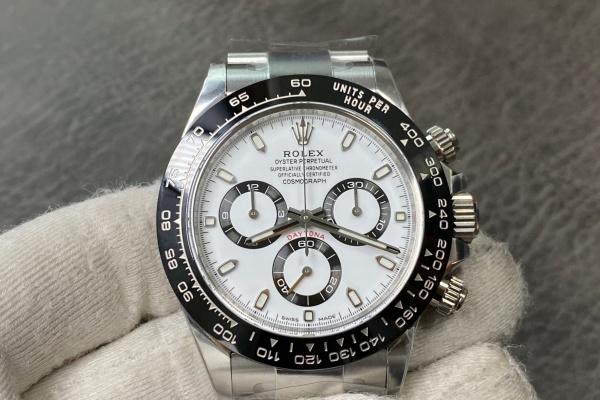
As an experienced dealer, I can tell you that since Rolex makes everything in-house, the methods for spotting a fake are pretty consistent across their models, including the Daytona. Many online guides tell you to look at dial color or shape. This is useless for a beginner. The differences are too subtle unless you have years of experience. Instead, I'm going to share a few simple, professional-level checks that are much more reliable for telling a real from a replica.
What's the easiest external sign of a fake Daytona?
You want a way to check a watch without opening the case back. But you don't have the tools or know-how. The serial number engraving is the best external clue.
A genuine Rolex serial number is deep and has a rough, sand-blasted look because it’s mechanically engraved. A replica uses a laser, creating a shallow, smooth engraving. This difference is clear under magnification and is a reliable sign of a fake.
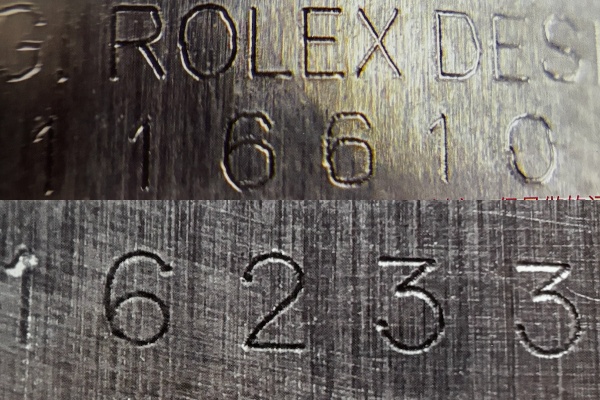
This is one of my favorite details to explain because it perfectly shows the difference in manufacturing investment. Rolex uses a specialized, expensive milling cutter to carve the serial number into the steel case. It's a single, powerful process. The result is a number that is deep and has a distinct, almost rough texture in the grooves. On the other hand, replica factories2 don't have access to this custom machinery. They use a standard laser engraver. The laser burns the surface, creating a number that is much shallower and smoother. To your finger, they might feel similar, but under a simple 10x jeweler's loupe, the difference is night and day. It’s an immediate giveaway to a trained eye.
| Feature | Genuine Daytona | Replica Daytona |
|---|---|---|
| Method | Mechanical Milling | Laser Engraving |
| Depth | Deep | Shallow |
| Texture | Rough, "sand-blasted" look | Smooth, clean lines |
| Appearance | Bold and rugged | Faint and precise |
Is the movement the biggest giveaway on a replica Daytona?
The dial and case on a top-tier replica look perfect. You start to wonder, what about the inside? Opening the case back reveals the single biggest tell on any replica.
Yes. A genuine Rolex 4130/4131 movement3 does not have a 'fast/slow' regulator lever4; it uses timing screws on the balance wheel. Even the best replica movements, like the Dandong 4130, still use a regulator lever to adjust the timing. This is a dead giveaway to a watchmaker.
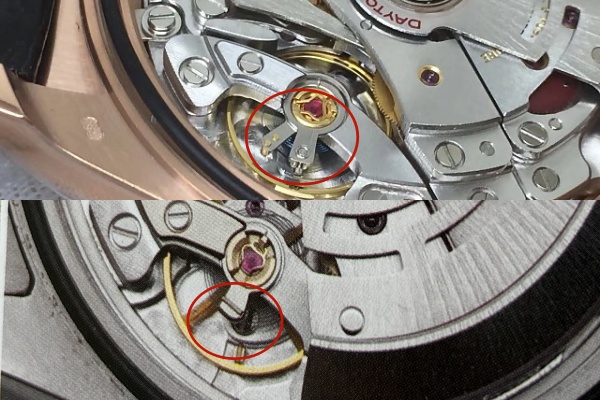
When a watchmaker opens the case back of a Daytona, this is one of the first things they look for. A regulator is a small lever that adjusts the timing of a watch by changing the effective length of the hairspring. It’s a standard feature on most mechanical movements. However, for their in-house chronograph movement, Rolex eliminated it. Instead, they use a "free-sprung" balance with "Microstella" timing screws directly on the balance wheel. This system is more stable and precise, but also much harder to manufacture and adjust. Replica factories, even top-tier ones making the amazing Dandong 4130 clone, stick with the traditional regulator lever. It’s cheaper to produce and far easier to regulate. For a watchmaker, seeing that lever is an instant confirmation that they are looking at a replica movement.
Can you tell by the engravings inside the movement?
You're looking for another layer of detail. What if you need more proof? The fine print engraved on the movement itself tells its own story of origin.
Absolutely. Using a loupe, you can see that genuine Rolex movement engravings5 are milled. The text appears wider at the top and narrower at the bottom. Replicas use lasers, resulting in shallow text6 with a uniform width. This is another manufacturing shortcut.
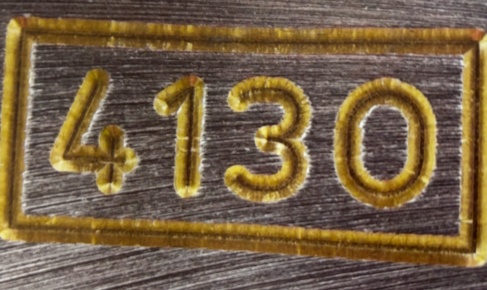
This check is very similar to the serial number inspection, but it's on the parts of the movement itself. If you look closely at the engraved text on a genuine Rolex movement bridge—like the model number "4130"—you'll notice something unique about the font. Because it's cut with a milling tool, the letters are three-dimensional. They are often wider at the surface and taper down to be narrower at the bottom of the cut. This gives the text a very sharp, beveled look. Replica movements, again, are engraved with a laser. The laser burns the text onto the surface, so the letters are shallow and have the same width from top to bottom. It's a flat, two-dimensional look7 compared to the sculpted appearance of the genuine engravings. These are just some of the ways to identify a watch, feel free to contact me to discuss more.
Conclusion
Telling a fake Daytona involves looking at manufacturing details like engravings and the movement's regulator. These tells are microscopic, proving how visually perfect top replicas have become.
---Understanding serial number engraving can help you identify genuine Rolex watches and avoid replicas. ↩
Learn about the methods used by counterfeiters to create replicas and how to avoid them. ↩
Discover the unique characteristics of Rolex movements that can help you spot fakes. ↩
Understanding the role of a regulator lever can help you identify replica watches. ↩
Learn the key differences in engravings that can help you authenticate a Rolex watch. ↩
Understanding shallow text can help you spot counterfeit watches effectively. ↩
Discover how engraving techniques affect the authenticity of luxury watches. ↩